Showing posts with label Justice League. Show all posts

Sunday, 23 May 2021

MBTI / Socionics: Justice League of America in the Bronze Age - from the seventies to the eighties


I. The late great Bronze Age


Here I want to use DC superheroes from the Bronze Age to give instances of the 16 types. I want to do this because of all the eras of comics, I like the Bronze Age (which spans the years 1970 to 1990) the best, and this is mainly because the Bronze is the one that I grew up with. 


As to when that Age began and ended, opinions differ. My view is that the beginning can be traced back to Neal Adams' debut on Batman and Green Lantern / Green Arrow; the end, to the publication of three first issues from Marvel: Jim Lee's X-Men #1, Rob Liefeld's X-Force #1 and Todd McFarlane's Spiderman #1. Lee, Liefeld and McFarlane ushered in a new style of comic book art, and after they had left Marvel to found Image, comic books officially entered the Chromium Age (or whatever you want to call it). In addition, the first appearance of Wizard magazine, which became the industry bible of the 1990s, also marks the passing of the age from Bronze to Chromium. 


Some authorities believe that the Bronze Age ended around the time of Crisis on Infinite Earths, Watchmen, Dark Knight Returns and Killing Joke. I cannot agree, but I do agree that the DC saw a change in tone after Crisis. DC declined in the late eighties, and the decline can be attributed not only to the damage to continuity wrought by Crisis, but also to the departure of old pros and fan favourites such as Curt Swan and Don Newton. 


To me, after 1985 or so, the company no longer felt like my DC any more. DC, to my mind, was better in the first half of the eighties: every DC superhero title published in 1981 I regard as compulsory reading, every title in 1988 not so much. In much the same way, Marvel suffered in the last years of the eighties - in particular, in the years right after Jim Shooter's firing. Bronze Age Marvel and DC in the last few years of the eighties both underwent a Ragnarok, a twilight of the gods. 


Objectively, much of Marvel and DC then seems better now, and I am sure that many of my readers can point out some hidden gems in DC's catalogue in that period; but I am here recording my impressions of DC at that time. My youthful evaluation was confirmed when I recently read some of the Celebration of 75 years DC anthologies (Aquaman: A Celebration of 75 years, Wonder Woman: A Celebration of 75 years etc.); the stories in these take a turn for the worse after 1985, and by the nineties and 2000s, are truly woeful. It is true that DC ensured that the stories of its flagship characters Superman and Batman were of a high quality and consistency throughout late 1980s and early 1990s, but in that same time period, it neglected its second-stringers (Wonder Woman, Aquaman, Captain Marvel, the Flash, Green Lantern...). 


II. Are DC heroes boring?


Taylor at Zombies Ruin Everything wrote a piece entitled 'DC Heroes are Hard to Type'. Of the 16 heroes here, five of them have been typed by Taylor, and I will be linking back to his profiles of them, but what is of interest here is why he did not type more: why does he find DC heroes so difficult? He implies that this is because DC heroes, in comparison to Marvel, are dull. Are they? 


In order to type these heroes, you need to wade through their early appearances, and for Justice League members Green Lantern, the Flash, Hawkman, the Atom, Elongated Man, Aquaman and the Martian Manhunter, their first appearances were published in the fifties and sixties - the Silver Age. And you will find these Silver Age stories hard going. They make dull reading, such that I found slogging through them a  real chore. Gardner Fox's and Mike Sekowsky's run on the Justice League offends the most. Denny O'Neil and Mike Friedrich rescued the title, but by that time (1968), the Silver Age was all but over.


In relation to this, after typing the Justice League, I have noticed that most of the characters at the front and center are what Keirsey calls Guardians - stolid and reliable types: that is, ISTJs, ESTJs, ISFJs, ESFJs. The presence of so many Guardians explains why the JLA was such a conservative - but dull - book for so many years. It only became interesting after two Artisan characters (see below) were introduced as series regulars, and this is no coincidence. 


III.  Why these characters?  


Here I have chosen one character for each personality type: I wanted to avoid doubling up on types. But that means I have left out a few important DC superheroes (which I may fit into a future installment). 


Why did I choose these particular characters? 


The first of my criteria is that the character must either be a superhero or an associate of a superhero: DC published many non-superhero titles in the Bronze Age - in the horror, Western, romance, fantasy and war genres - and I wanted to avoid these. That means, then, that DC standbys such as Sergeant Rock, the Unknown Soldier, the Warlord, and Jonah Hex will be excluded. 


The second criterion is that the character must have had their own series, even if it was a back-up or filler. (All the characters I have typed here, including Black Canary, had either their own title or back-up run). Does the character have his own adventures, sub-plots, supporting cast? Can the character stand on his own? If so, this helps me get a grip on him, whereas characters who appear only in team books present me with a great deal of difficulty. The majority of the heroes in the Legion of Superheroes (which has a big roster) cannot be distinguished from another, and as such, I cannot type them. 


I have here grouped the characters into what Socionics calls Quadras, that is, types who share the same four functions in their MBTI stack. The Quadras concept sheds light on values that certain types have in common, and I think it is useful here. 


IV. The Alphas - SFJs and NTPs


Superman - ESFJ 


Typed by Taylor here. The character needs no introduction. 


MBTI explains why Superman is such a down to earth and comfortable character despite having the powers of a god. 


Extraverted Feeling gives a character regard for the others around him - the well-being of the collective - whereas Introverted Sensing means that the character makes a character pay attention to the near at hand and small details. In combination, the two functions Fe and Si add up to a credo of 'Love those closest to you', which is what makes ESFJ male characters great parents and family men. 


Superman's powers do not work against magic, and not coincidentally, Introverted Intuition - the function most commonly associated with the supernatural - occupies the vulnerable function slot in the ESFJ type (see Socionics). 


The Atom / Raymond Palmer - INTP


Ray Palmer, a nuclear physicist, harnesses the power of a dwarf star meteor and uses it to shrink himself - to the atomic and sub-atomic levels. The INTP stock type is the quiet and shy mad scientist - think Bruce Banner, Peter Parker, Hank Pym - who is rather squeamish of violence and force. 


The INTP is an Intuitive, and as such, he disregards the sensory. He lives in a world of abstractions and ideas and seeks to go beyond the physical. Hence, he shows a creative flair. 


The Flash / Barry Allen - ISFJ


A shy and humble man with a quirky sense of humour, Barry Allen works as a police scientist and one evening, while in his laboratory, he is struck by lightning which gives him the power of super-speed. 


The ISFJ character feels contented regarding his station in life - he is happy with his lot - and this complacency can be a source of dissatisfaction in those around him. Barry Allen, being disorganised, is frequently impunctual, and is called by his girlfriend Iris West the 'slowest man alive' (this is ironic, as she does not know he is secretly the Flash). Again, the Socionics concept of the vulnerable function plays a role here: the ISFJ's type is Extraverted Thinking (Te), that is, organisational and business logic, and this helps explains why Barry is so impunctual and disordered. 


Iris subtly bullies Barry quite a lot in the Silver Age issues, and this is another trait of ISFJ characters: they are put upon by others (until they explode). 


The Elongated Man / Ralph Dibny - ENTP


As a youth, Ralph Dibny aspired to be a contortionist, and as an adult, he discovers a drink called Gingold which gives one stretching power. Like other stretching heroes Plastic Man and Mr Fantastic, the Elongated Man can assume wild and unpredictable shapes. After becoming super-powered, he sets himself up as a detective. His nose starts twitching uncontrollably whenever a mystery is afoot. 


Clearly, he is an Intuitive, and an Extravert as well. Dibny wears a mask in his first appearances as the Elongated Man, but discards it and makes his identity public because he desires fame. 


NTPs such as the Elongated Man and Sherlock Holmes make good detectives because their Introverted Thinking (Ti) and Extraverted Intuition (Ne) work in combination, allowing them to scent out possibilities and discover the operating principles behind all things. 


VI. The Betas - NFJs and STPs


Wonder Woman / Diana Prince - ENFJ


Typed by Taylor here. Another character who needs no introduction. In her first appearances in the Golden Age, her creator William Marston Moulton used her series as a vehicle for propaganda. Marston upheld a rather strange philosophy on how the sexes should behave to one another, and it permeates every single Wonder Woman story he wrote. The philosophy is ubiquitous, and so is bondage - Wonder Woman and other female characters are tied up or bound in chains in every story as well. The unique preoccupations of her creator set Wonder Woman apart from other female superheroes. 


Fe-dominant characters can give the impression of being bossy and overbearing, and this is true of Wonder Woman in the Golden Age years. By the time comics entered the Silver Age, she gradually becomes more refined, and at this point, what Keirsey calls the 'Idealist' aspect of the ENFJ type reveals itself. Like the ESFJ, the ENFJ loves those around them, but unlike the ESFJ, the ENFJ loves them in the abstract. The Introverted Intuition in the ENFJ type allows them to perceive beyond the immediate and into the transcendant - the world of ideals and absolutes. Hence Wonder Woman's giving speeches to the UN. 


The Huntress / Helena Wayne - ISTP


The Huntress character comes in two iterations: one of them, the post-Crisis version (Helena Bertinelli) is typed by Taylor here. The first Huntress was created by Joe Staton and Paul Levitz in the seventies and was killed off in the eighties as part of the Crisis- event. 


Helena Wayne, the daughter of the Earth-Two Batman and Catwoman, takes up the superhero mantle after her mother is framed for a crime she did not commit. After Catwoman dies at the hands of a criminal, Bruce Wayne - now retired as Batman - sinks into a depression while his daughter vows revenge. (In a strange development, the Earth-2 Bruce Wayne replaces Jim Gordon as Gotham's police commissioner, and on coming out of retirement as Batman for one last time, is electrocuted by a super-villain). 


A beautiful brunette with long flowing hair and a knack for martial arts and weaponry, the Huntress recalls another ISTP female, Elektra. Like Elektra, Huntress fights male characters and usually endures a beating at their hands - which may make readers of today's sensibilities uncomfortable - but, like the true ISTP 'bad girl' she is, she overcomes whatever is thrown against her. 


Madame Xanadu - INFJ


A minor character who headlines in a few horror / supernatural titles in the late seventies and early eighties and later teams up with superheroes such as Wonder Woman and Superman, Madame Xanadu lives in Greenwich Village, New York. I will reproduce here some evocative passages from her entry in DC's Who's Who #14: 


A sign on the front door of the Christy Street shop reads 'Enter freely - unafraid'. The door always seems locked to those who are just wandering by, giving it a curious glance, but for those troubled by things beyond the ken of this world, the door is always open, no matter what the time, and Madame Xanadu waits within and greets them by name. 


She waits, ready to listen, near a small round table where her Tarot cards lie. The frightened travelers, coming inside, are surrounded by a comforting scent of mint-jasmine, and a curious collection of crystal jars, magical artifacts of all types, and endless rows of books with ancient bindings containing a wealth of esoteric knowledge. 


The INFJ stock type performs the function of prophet or counselor: Madame Xanadu, to quote Who's Who, 'Is only allowed to advise, and hope that the subject can see to the core of his dilemma, and can bring his own determination to bear in resisting its influence'. Introverted Intuition Ni allows the INFJ to see the future and Extraverted Feeling compels the INFJ to share those insights with humanity. 


Interestingly, Madame Xanadu's Ni perceives bad events happening in the future, not good - like Cassandra. Her task then becomes one of using her powers to avert danger to others. Who's Who again: 'Madame Xanadu's parlor is filled with artifacts that can be used as weapons, and books of knowledge that contain even greater power', but 'She can only collect the evils that are left over afterward, and keep them hidden away until the day when they no longer have any power over this world'. 


Lois Lane - ESTP


Typed by Taylor, she needs no introduction. 


Lois Lane appeared in her own book Superman's Girlfriend Lois Lane, which ran from 1958 to 1974, and then in the anthology series Superman Family, which ran from 1974 to 1982, and of course she turns up in other Superman titles from that period. Like Jimmy Olsen, she is featured a lot in the DC Bronze Age universe, and like Jimmy Olsen, she today gets little credit for her long service as a staple character - too few of her solo stories are reprinted. 


The stock ESTP character is more often than not a bruiser and a brawler: see Thor, Lobo, Conan the Barbarian... When you, as a writer, need to portray an ESTP woman, and moreover, an ESTP woman without super powers or great fighting ability (but Lois is adept in the Kryptonian martial art of Klurkor), you are faced with a challenge: how do you do it? The answer is that you give that character tenacity and vivacity as well as a certain slyness and cunning. You add force, wilfulness, territoriality (Extraverted Sensing Se) to systems analysis (Introverted Thinking Ti). 


Lois Lane has been romantically involved with Superman almost since her first appearance, but Socionics tells us that Lois' type ESTP does not make a good match with Superman's ESFJ. Socionics calls that relationship one of Request, which you can read more about here. Lois, from the point of view of Socionics, would have been better off with an INFJ, but INFJs are in short supply in the DC Bronze Age universe, and so, in order to find one, she would be best advised to cross over into the Marvel universe: there she could meet Professor X or the Silver Surfer or the Vision.  


VII. The Gammas - NTJs and SFPs


Batman - INTJ


Typed by Taylor here. 


The vast majority of INTJs in Bronze Age Marvel and DC are villains; INTJ heroes do exist, but are rare. 


Something that all INTJ heroes (or anti-heroes) have in common is this: they prefer to use as a base of operations dark and enclosed environments which are cluttered. That is true of Batman, Walter White, Doctor Strange, Jason Blood (of DC's The Demon)... The strangeness of the INTJ's milieu - often the cluttered environments are filled with curious objects - reflects the strangeness of the INTJ's inner world. 


The dark and cluttered Batcave presents a contrast with the bright and spacious Fortress of Solitude. Interestingly, Socionics says that the relationship between an INTJ (Batman) and an ESFJ (Superman) is one of Conflict. 


Green Arrow / Oliver Queen - ESFP


Green Arrow first appeared in the 1940s as a Batman clone who had his own Arrow Car, etc., and this version of Arrow - who lasted through the Golden Age and Silver - I would probably type as an ESTJ. But, by the late sixties, Denny O'Neill changed the character's look and personality type: Oliver Queen became 'Ollie'. Extraverted, friendly, and given to emotional outbursts - much like his Marvel counterpart Hawkeye - Green Arrow was transformed into an ESFP. A street-level character, he became obsessed with social issues, and this obsession made him a good fit with the times. Some classify his politics as ultra-liberal, but I do not think he subscribes to any particular ideology. Ollie acts like Ollie because of his personality type. Gulenko writes that '[The ESFP's] strong point lies in his ability to rally a large group of people against something', and this is something that Ollie does a lot. Some find this trait of Ollie's overbearing and they regard him as sanctimonious. But the debut of Ollie signified a real change - a sixties change - from the run of the mill DC hero. 


As an ESFP, Green Arrow belongs in what Keirsey calls the 'Artisan' category. Many Artisan heroes tend to be skilled with melee weapons such as bows, crossbows, staves, swords, daggers. 


Black Canary / Dinah Laurel Lance - ISFP


The original Black Canary appeared as a companion to Johnny Thunder in the 1940s. A thief and an anti-heroine, I would type this iteration of the Canary as an ESTP - like Catwoman, who she much resembled. After reforming, she became a conventional heroine. By the 1960s, she had been shuffled off to Earth-2 - like all of DC's Golden Age characters - but towards the late sixties she made the unusual step of crossing over from Earth-2 to Earth-1. 


At least, that is what we thought. In an elaborate and bizarre retcon, DC made the Earth-2 Canary the daughter of the Earth-1; she had been brainwashed into thinking that she was her own mother (the original Canary was kept, along with her husband Larry Lance, in suspended animation in another dimension). 


Unlike the original Canary, the successor had a super-power - a sonic scream (like Banshee's from the X-Men) - which she gained after travelling to Earth-1 and joining the Justice League. Denny O'Neill was responsible for this change, as well as the change from Oliver Queen to Ollie. 


Canary, by the time of O'Neill and Adams' groundbreaking Green Arrow / Green Lantern run, formed a relationship with the easygoing and cheerful Green Arrow. But she remained - like many an Introverted Feeling-dominant (Fi) female character - an aloof individualist bent on pursuing a path of self-discovery, and this made her relationship with Arrow stormy. As in the case with Green Arrow, her attitudes come less from politics than personality type. In many of her appearances, Black Canary often is shown riding a motorcycle into the sunset, an act that symbolises her type's appetite for freedom. 


Fi-dominant characters can give the impression of being cold, icy, withdrawn, and prone to making categorical value judgments. Black Canary is no exception.


An Artisan character is usually skilled with melee weaponry, but the Bronze Age Canary does not wield any weapons; but she is a skilled martial artist. 


Batgirl / Barbara Gordon - ENTJ


Typed by Taylor here. 


Barbara Gordon is created by Gardner Fox and Carmine Infantino and makes her first appearance in the Batman title; she goes on to appear in her own solo stories in the late sixties. A number of these were penciled by the great artist Gil Kane. By the seventies and eighties, the artists Don Heck and Jose Delbo become most commonly associated with Batgirl, and it is their stories which helped make Batgirl a distinctive character. 


The ENTJ personality type, like the INTJ, more frequently plays the villain than the hero in Bronze Age comics. I can only think of one major hero character other than Batgirl who is an ENTJ: Namor, the Sub-Mariner. 


Why are ENTJ heroes rare? In comics, the Extraverted-Thinking dominant type more often than not wants to rule the world, or at least his portion of it, and if that Te-dominant has Introverted Intuition as a secondary function (which the ENTJ has), then he has the gift of forward-planning, assessing probabilities. This makes him a mastermind stock type, and the standard superhero is not suited to that role. Why? The ENTJ type is by nature a politician, a ruler of men, who has far-sighted vision, and most superheroes are not politicians; Barbara Gordon, who served as a Congresswoman, is the exception to the rule. 


Like all the members of the Batman family, Batgirl possesses great martial arts ability; but the real focus of her talents lies in her intuition - like Batman and Nightwing, she is an Intuitive, and an Introverted Intuitive at that. To my mind, one area in which her Introverted Intuition (Ni) manifests itself is in her photographic memory, which is one of her unique skills. 


VIII. The Deltas - STJs and NFPs


Green Lantern / Hal Jordan - ESTJ


Writer John Broome and artist Gil Kane created Hal Jordan in 1959 and constructed for him an extremely well-thought and detailed world, which the Green Lantern series has traded off for sixty years. 


As we know, Dennis O'Neil and Neal Adams revamped the character and took him from the Silver Age into the Bronze. After Adams' departure, Mike Grell and Joe Staton were the artists associated with Bronze Age Hal, and British artist Dave Gibbons did a memorable run in the 1980s. 


Hal Jordan left the series and handed over his power ring to John Stewart after Crisis. Appropriately, the title concluded in 1988 - right towards the end of the Bronze Age - after thirty years. 


The ESTJ type is a Sensor, not an Intuitive. I wrote before that usually the Intuitive character is associated with strange, usually mystical, powers. Given that the power ring gives its wearers these odd powers, cannot the case be made that Hal Jordan is an Intuitive, not a Sensor? 


The answer is no. Jordan uses the ring to make force objects: clubs, hammers, buzzsaws, eggbeaters, propellers... The energy blasts the ring emits are concussive in nature, much like Cyclops' or Starfires' (both Sensors). If you read the adventures of Alan Scott, the Golden Age Green Lantern, you will see that the power ring's effects were much more ethereal for Scott, who was not a Sensor. 


Taylor writes that the ESTJ male character is a college jock. That designation fits Hal Jordan, who is handsome, athletic, two-fisted, occasionally hot-tempered but always likeable and even charismatic. 


Zatanna - INFP


A sorceress character who first appeared in the Silver Age, Zatanna is the daughter of Zatara, a Mandrake the Magician clone. In the early sixties, she teams up with a number of Silver Age heroes in order to find her father, who has gone missing. As it turns out, he is being held captive by an old enemy in another dimension. After rescuing him - with the help of Green Lantern - Zatanna goes on to join the Justice League, and change her costume several times - with controversial results. 


Zatanna reminds me of another sorceress character, Marvel's Scarlet Witch, who is another INFP. One of the distinguishing traits of so many INFP characters is that many of them have a mysterious parentage: they and other characters do not know their true parents are. Usually they are orphaned or adopted, or the person they think is their real father or mother is not. This is the case with Marvel's Nightcrawler, the X Files' Fox Mulder, Star Wars' Luke Skywalker, DC's Mister Miracle... In the late seventies, Zatanna and the Justice League, in a multi-story arc, go on a quest to find her real mother, who supposedly died in an accident when Zatanna was a child, only to discover that her mother is a member of a mutant species (called the 'Magi') and still alive in another dimension. 


Another trait of the INFP is that they are always searching for freedom and self-actualisation: as Mister Miracle declares, 'Let me be Scott Free - and find myself'. The INFP character's introversion makes this a solitary pursuit, and the INFP's being an Intuitive and a Feeler forces the character to ignore the present reality and focus on the bright horizons - much like Luke Skywalker in the first half of Star Wars (1977). 


Hawkman / Katar Hol - ISTJ


Like Green Lantern and the Flash, the Hawkman of the Silver Age is modeled after a Golden Age character, the first Hawkman, Carter Hall. But whereas the creators of the Golden Age Hawkman took inspiration from the occult for his origin story - he is the reincarnation of an Egyptian prince - the creators of the Silver Age Hawkman took it from science-fiction: Katar Hol, a lawman from the planet Thanager, travels to Earth along with his wife Shayera to study Earth law-enforcement methods. For some reason, he uses medieval Earth weapons such as the mace and the crossbow, and gladiator weapons of ancient Rome such as the cestus (spiked boxing gloves) and the net. All this combines to make Katar (in the words of artist George Perez) a 'great visual' and a joy to draw, but as a character, Katar is one of the dullest in the DC universe. The great Joe Kubert gives the first Hawkman stories some real atmosphere, but after Kubert, the pedestrian Murphy Anderson takes over the reins and makes Hawkman workmanlike and dull - and a perfect fit for Silver Age DC. In the Bronze Age, Hawkman appears as a regular in the Justice League series and as a guest in team-up books such Brave and the Bold; he also appears as the lead in back-up features and his own solo titles (which never caught on). 


The question is why this was so. Part of the reason is that DC never lavished the same attention on world-building for Hawkman as they did on, say, Green Lantern; in the same way, Marvel neglected the X-Men after the first few issues by Lee and Kirby, such that the series was in danger of being canceled by the mid-seventies.                                                                                                                                                                                                                                                                                                                                                                                                                                                                                                                                                                                                   

But I think the answer lies in Hawkman's being an ISTJ, a personality type which, in comics, usually is the dull background character who is officious but makes things work. Such a character can succeed in drawing the attention of readers only if the world live in is a crazy and off-kilter one - like Judge Dredd's (Dredd is an ISTJ) - and such a setting only highlights the virtues of the stolid and reliable ISTJ type. As it is, the strait-laced Kater is used as a comic foil to the more unconventional and gregarious members of the Justice League (Green Arrow, then Blue Beetle). 


The creators of the Golden Age Hawkman more or less stole his look from the Flash Gordon characters the Hawkmen of Mongo (who first appeared in the Flash Gordon comic strip in the early 1930s); and they swiped art from another 1930s strip, Prince Valiant. The consequence is that by the seventies the Hawkman character looked and felt old-fashioned, an impression heightened by the fact that his Thanagarian rocket ship looked like a space craft left over from the 1950s. Hawkman, unlike nearly every other DC hero, was never given a makeover to make him more suitable for the 1970s and 1980s. 


To their credit, DC did try. In the 1980s, they re-launched Hawkman in a pair of limited series which ran from 1985 to 1987; Tony Isabella and Richard Howell did most of the writing and pencilling respectively. Many Hawkman fans regard this arc as Hawkman's finest, but it did make a change to the Hawkman mythos in a major way (and not for the better): the Thanagarians became a race of evil manipulators and schemers - much like the Romulans in Star Trek - and Hawkman's antagonists, and this was not what Katar Hol's creators intended. The theme of the outsider superhero locked in struggle against his own evil, world-conquering race could have been a compelling one had it been there from Hawkman's beginning, but it wasn't - in Hawkman's origin story, the Thanarians were as benevolent as the Kryptonians. And once you as a writer have a hero or a heroic race commit evil acts for which there is no redemption, then you have left them with no going back - which is what the writers of Green Lantern in the 1990s discovered. 


I think the Hawkman stories of the first half of the 1980s were much more true to the character. (Some of these admittedly were quite jarring. For instance, in one arc, Katar's wife Shayera (Hawkgirl) becomes bad-tempered and standoffish to Katar, and then leaves him to 'find herself'; Katar sinks into a depression, forgets to shave, starts drinking, neglects to clean up his apartment... As a young reader, I found this to be too much like real life, and now I can only surmise that the writer Bob Rozakis was going through his own trauma - perhaps he had become separated or divorced). The best of the Bronze Age Hawkman stories were pencilled by the eccentric underground artist Ken Landgraf. 


Jimmy Olsen - ENFP


'Boy reporter', 'Superman's Pal' and 'Reporter of a 1000 Faces' Jimmy Olsen first appeared in the Superman comics in 1940, and had his own series, Superman's Pal, Jimmy Olsen which ran from 1954 to 1974 for an astonishing 163 issues before it changed its name to Superman Family; the series came to an end in 1982. You would expect - given the length of the character's tenure - DC to publish all the stories in deluxe Omnibus editions, but alas, they have not, and I suspect that this is partly because DC regards Jimmy as an embarrassment, as do most Superman fans. Why? The answer lies in Jimmy's personality type, the ENFP. Characters of that type tend to be bizarre, whimsical, corny - and annoying. Many ENFP characters such as Mr Mxyzptlk in Superman, Bat-Mite in Batman, and Impossible Man in Fantastic Four exist to get on peoples' nerves: they are pests. On top of that, they are stupid as well; EJ Arendee, who used to do MBTI videos on YouTube, once said that ENFPs were the stupidest of all the personality types. That was mean of him, but all the same, stupid is the right adjective for comic book ENFPs. All this explains Jimmy's peculiar status in the DC canon. During the Silver and Bronze Ages, fans found Jimmy's unique personality traits endearing, but now, in the 21st century, they do not. Indeed, Jimmy fell out of favour long ago: can you imagine a Jimmy in the 1990s revamped to be 'grim and gritty', 'dark' (maybe by Rob Liefeld or Jim Lee)? You cannot, of course, because Jimmy belongs to a more innocent time. 


Superman's Pal enters the Bronze Age with a story published (appropriately enough) in January 1970, in which Jimmy confronts a slum lord; it was about this time that DC tackled subjects of social relevance - you could say that, in the 1970s, comic books entered a 'grim and gritty' phase. As to who brought Jimmy into the Bronze Age, it is Jack Kirby who takes the credit with his famous 16-issue run, but to my mind, it is Kurt Schaffenberger, who drew most of Jimmy's stories in the 1970s, who is more responsible; Schaffenberger ditched Jimmy's trademark bow tie, green blazer and plaid pants, and outfitted him with canvas bell-bottoms and a safari jacket. Jimmy makes the transition from Boy Reporter to Mr Action. 


The late 1970s saw Jimmy's best arc: an ambitious four-parter (!) (well, that was ambitious for the seventies) which crossed over with Lois Lane's title and featured characters from the Teen Titans. In it we saw the return, from Kirby's trailblazing run, of the Golden Guardian clone, the DNA Project, Dubbilex, and the Newsboy Legion. I loved it as a boy, and re-reading it now, it still fascinates; my only regret is that Kurt Schaffenberger did not pencil the final story. 


Mark Hootsen signing off. 


Friday, 8 April 2016

MBTI: HOW TO TYPE SUPERHEROES


Comic books differ from other art forms - novels, plays, TV shows, movies - and we are faced with a different set of problems when typing a comic book character as opposed to one in a TV show.

When typing characters on a TV show such as Bold and the Beautiful, it's best to proceed as follows: get to know the 16 types and their little quirks and foibles really well and then attempt to recognise such-and-such a character as a typical instance of a certain type as seen in a TV show, comic book or movie.

On TV, character - and MBTI - is revealed to us in flashes: TV shows give us little pieces of a character at a time (from which we can divine a character's type). TV shows (and movies) can trace their forebear to the play, which is the oldest dramatic art form, and plays (according to Aristotle) only show slices of a character - not all of a character's life, only the most important moments of the character's life.

While comic books portray slices of life, comic book characters - especially superheroes and supervillains - reveal their type to us not only through their personality traits but their powers and abilities. As we shall see, some superpowers are more suited to an Intuitive type than a Sensor and vice versa.

If you cast your mind back to the superhero role-playing and card games of the 1980s and 1990s, you'll recall that usually each character's statistics reflect their strengths and weaknesses in certain areas. One of Superman's weaknesses lies in the field of the supernatural and magic, while Doctor Strange (as 'Earth's Sorcerer Supreme') exhibits mastery in that domain; the Silver Surfer possess the 'Power Cosmic', and is classified (along with Adam Warlock, Thanos, Galactus and Captain Marvel) in the Heroclix game series as a 'cosmic', while Spiderman doesn't show any propensity towards the 'cosmic' at all. One of my arguments here in this article is that these dichotomies - supernatural versus scientific, cosmic versus earthbound and others like them - bear upon MBTI and socionics.

I. Sensor or Intuitive?


We can define that dichotomy - Sensors versus Intuitives - in superhero land as being one of brains versus brawn. Characters whose powers and abilities tend to be mental (e.g., telepathic) or supernatural more often than not should be classified as Intuitives; so should characters whose ability (as opposed to superpower) could be said to be mental and intellectual (perhaps the character is a detective or a scientist) or consisting of some intangible quality such as 'charisma' or 'leadership'. On the other hand, Sensors will have, more often than not, a main power or ability based on strength, force and the use of weaponry; sometimes they will possess enhanced 'super-senses' (e.g., Wolverine, Daredevil). Intuitives tend to dwell in the mental or spiritual realm, Sensors in the material and sensory.

Take a look at some of the X-Men from the Chris Claremont years. Jean Grey, Professor X, Nightcrawler, Storm, Kitty Pryde, Longshot, Beast belong in the Intuitive category; Cyclops, Wolverine, Colossus, Rogue in the Sensor. Remember that Cyclops' main ability is to blast things with force beams from his eyes - force blasts, force bolts, the power to construct energy barriers and shields ('force manipulation') are a Sensor's power. Storm's power (weather control) and Nightcrawler's (teleportation) require a mental effort as opposed to the physical; or, to put it another way, an effort of thought as opposed to an effort of will. You could say that Nightcrawler must use intuition - extraverted intuition, Ne - to avoid teleporting ('bampfing' as he calls it) into the wrong place.


A character can start out as a Sensor and transform into an Intuitive, or vice versa. In her first appearance in an Avengers annual, Rogue plays the role of villain with the ability to siphon off or steal the super-powers and characteristics of superheroes - which, at first sight, makes her seem an Intuitive. But, after she steals Ms Marvel's powers and becomes an X-Men regular - and it's in that series that we get to know her - she becomes super-strong, super-fast, invulnerable; in short, she becomes a Sensor. Likewise, the Beast may seem to be a Sensor, but we mustn't forget that before he became a mutant he was Hank McCoy, a super-scientist, and, like Tony Stark / Iron Man, a rather extraverted and loquacious one at that. The fact that such an obvious Intuitive winds up as having the superpowers of a Sensor represents an intended irony; we find the same irony at work in Spiderman, a geeky and nerdy Intuitive who becomes super-strong.

In the Fantastic Four, we find two Sensors, two Intuitives. Mister Fantastic, as we know, can stretch, turn himself into rubber balls and all sorts of things, but let's remember the defining trait of the character (which made itself felt even before he gained superpowers): he's a brilliant inventor and scientist. That makes him an Intuitive... Like Green Lantern, Invisible Woman can construct invisible force-fields and objects which can be used as battering rams, etc., but these abilities were a later addition. Originally she was known for being able to turn herself (and objects and other people) invisible: more of a mental power than a physical. In contrast, the Thing owns a rocky and impervious body and can lift huge objects. This, to me, makes him a Sensor, and, what's more, can be related back to introverted sensing Si, which, as we know, involves physical strength, physical toughness and self-discipline. As for the Human Torch, his powers manifest themselves in the physical realm in a spectacular way. He blazes fire trails through the sky, makes and throws fireballs, overheats and blows up robots and machines, goes supernova... These demonstrate force, will, and force and will imposed on others - extraverted sensing Se.

In the case of the 'A-list' of DC characters, we find Sensor heroes Superman, Green Lantern, Green Arrow, the Flash and Intuitive heroes Batman, Robin and Wonder Woman. Green Lantern uses will power to make objects with his power ring, the Flash uses super speed to make his body a weapon (able to saw through objects or burn them up using friction, for example) - powers which are based on the sensory and the physical. Batman and Dick Grayson use their mental abilities to do detective work (as does Sherlock Holmes, another Intuitive) and are escape artists (like Mister Miracle, an Intuitive). Wonder Woman, as we know, can lift heavy objects, which should make her a Sensor, but I argue that an intangible quality - moral leadership or charisma - makes up her main ability, an ability she shares with Dick Grayson / Nightwing. Taylor types both Grayson and Wonder Woman as ENFJs, and ENFJ super-characters usually display an intangible, intuitive ability to lead and inspire (and manipulate).

We know that Magneto, Darkseid and Namor the Sub-Mariner possess all sorts of powers, but, if we're to trace back a main, or prime ability in these three, it's the ability to lead (or inspire fear in) men. The same goes for other Intuitive leader-types the Kingpin, the Red Skull and Loki.


The lesson is that we must always look at the fundamentals. In the case of the Spectre, we could be forgiven for thinking that he'd be an Intuitive like so many other Marvel and DC supernatural characters - e.g., the Phantom Stranger or Doctor Strange. But if you've read any of the Spectre comic books, it becomes clear early on that he's an ISTJ - a Sensor. That's because the character started out as an ISTJ: he's a police detective, Lieutenant Jim Corrigan, who comes back to life after being murdered by criminals as a vengeance-driven spook. That theme - the ISTJ as a vengeful supernatural entity - appears again and again in horror. Likewise, Boston Brand / Deadman, before being murdered, is a circus performer and a Sensor; ironically, he becomes transformed, after death, into a character with superpowers we normally associate with Intuitives - he turns into a ghost who can take over people's bodies.


I'll note here in passing that Sensors, particularly the extraverted-sensing ones, seem to be drawn to the use of weapons. Think of Daredevil (billy clubs), James Bond (handguns), Wolverine (claws), Elektra (sai daggers), Deathstroke the Terminator (swords and staves), Valkyrie from the Defenders (swords)... The archer characters spring to mind here also: both Oliver Queen / Green Arrow and Hawkeye are Sensors and both use bows and arrows. All these characters display an uncanny virtuosity when using their weapon of choice.


II. Thinker or Feeler?


Thinking and feeling make up, in socionics and MBTI, the two judging or 'Rational' functions. We make value judgements using either thinking or feeling, as do comic book characters. Dialogue and interplay gives us a fairly good idea of how a character will react to a certain situation and what value judgements they will make.

We see that in the famous Green Lantern and Green Arrow team-up stories by Neal Adams and Denny O'Neil . When confronted with an ethical dilemma, Green Lantern - as a Thinker - will consult the law: he asks himself, 'How does this look objectively and from the standpoint of accepted rules, morals, manners and customs?'. Green Arrow, on the other hand, will emote straight away. He reacts, instantly, and gives his interpretation - based on his own deeply-held moral convictions.

In the comic books, thinker characters tend to be  logical, detached, rational - but not always more intelligent - and calculating; if they don't possess much in the way of morals, they'll use deception if need be. Feelers, on the other hand, show an absence of guile and often find it difficult to detach themselves from their emotions and look at things objectively. Extraverted feeling revolves around what others feel and what their opinions, morals, habits are; introverted feeling, one's own moral evaluations and emotional reactions. A catchphrase of an extraverted Feeler superhero such as Superman is, 'Don't do that - it will hurt other people' ; for an introverted Feeler, 'Don't do that, because I don't like it'. Whereas, for extraverted thinkers such as the Punisher and Batman, things may be prohibited because they are unjust and go against The Law with a capital L -  a higher law than that of the America criminal justice system.

In the X-Men, Wolverine, Cyclops, Storm, Beast number among the rational and calculating types, whereas Professor X, Jean Grey, Nightcrawler, Colossus, Rogue, Kitty Pryde should be thought of as Feelers. The difference is illustrated by the contrast between Magneto and Professor X. Magneto, being a Thinker, looks at events from a calculating and technocratic perspective; Professor X's perspective, on the other hand, strikes us as empathic and moralistic, and always has a view to the common good. You see here the difference between extraverted thinking Te (Magneto) and extraverted feeling Fe (Professor X). Keirsey would classify Professor X, an NF (Intuitive Feeler) as an 'Idealist', Magneto, a NT (Intuitive Thinker) as a 'Rational'.


But wait, Thinking types - who have either Te or Ti as a judging function - get emotional, don't they? Obviously so: they can become just as emotional as Fe or Fi types. The difference lies in how they evaluate their experiences. The first question the Thinker type asks himself is, 'What are the rules on this? How does this thing work?'. Whereas the Feeler is more interested in the question of how such-and-such affects the group atmosphere or dynamic (Fe) or one's deeply personal and natural reactions (Fi), which can be ones of empathy or antipathy. It's how you sum up life - how you evaluate it - that counts.

This goes some way to explaining why some very intelligent characters such as Professor X - who invented the Danger Room and Cerebro, among other technological marvels - should be considered as Feelers, not Thinkers; and why some very ditzy characters such as Lois Lane or Janet Van Dyne are calculating Thinkers (after all, Lois Lane is (in the old comic books at least) always plotting how to get Superman to marry her; the Wasp does the same with Hank Pym).

III. Perceiver or Judger?


Taylor gives a good description of the differences between Perceiver and Judger below:

Judging or Perceiving (J/P)- Judging or Perceiving determines your lifestyle. While Judgers are more strict in their routines and prefer to have things finished, Perceivers are more likely to be okay with leaving things up in their air. Judgers go by a set of externalized rules that keep everything in place, while Perceivers live by internalized principles that guide them and only them. Like dogs and cats.

As Chad Crandall puts it, Judgers appear as 'mappers', Perceivers as 'explorers'.

Here's where it gets difficult. Spiderman, as an INTP, would, in socionics, be called an INTj - the small 'j' comes about because his dominant function (Ti) is a judging function. But, in MBTI, he's an INTP: the uppercase 'P' at the end signifies that his extraverted function is the perceiving one. And Spiderman (in comparison to the Punisher, for example, who is an ISTJ) seems more of a Perceiver than a Judger. So what gives?

I think that the point MBTI is trying to make is that the extraverted primary or secondary function determines how we appear to others: the extraverted function is the one the world sees, and the one that makes one (in the eyes of the world) a Judger or Perceiver. Barry Allen (the Flash in the old Silver Age DC comics) works as a police scientist and leads a structured and ordered life which we'd expect of a Judger. As an ISJF, his judging function - feeling - is extraverted and so it's the one that the rest of the world sees. And indeed, his rather snippy fiancé, Iris West, calls him a 'tortoise'.


It's not entirely true to say that Judgers (in MBTI) want to impose their values on the world while Perceivers don't - all the types, to a certain extent, seek to impose their values - but a great deal of truth exists in that assertion. Take the difference between Doctor Doom (a Judger) and Mr Fantastic (a Perceiver). Doom leads an orderly, structured life and works towards goals, and both activities involve other people: he wants to: conquer the world, rescue his mother from her imprisonment in Mephisto's hellish realm, destroy the Fantastic Four... This is what the world sees of Doom. Whereas, in the case of Reed Richards, we see a man who engages in scientific research for its own sake. He doesn't want to bring the world to heel. What's more, his extraverted function (the one the world sees), which is Ne, doesn't lend itself to world-conquering.

A Judger such as Doom wants the world to follow his rules (or at least expects, like Barry Allen, the world to follow a certain structure and is disappointed if it doesn't).

Judgers seem to be more rooted than perceivers. In the Fantastic Four, the two Judger characters in the foursome, the Thing and Invisible Woman serve to keep the team grounded - a necessity when the other half of the team (Human Torch and Richards) are Perceivers and somewhat flighty.

In the Claremont-era X-Men, we find plenty of Judgers - Professor X, Jean Grey, Storm, Rogue (surprisingly enough), Cyclops - who contrast against the 'wild card' Perceivers Wolverine, Kitty Pryde, Nightcrawler and the Beast. Likewise, in the seventies-era Defenders, the Judgers (Doctor Strange, Nighthawk) serve as a counterweight to the comparatively more erratic and unstable Valkyrie, Hellcat and the Hulk. In the eighties-era New Teen Titans, we find a lot of Judgers - Robin / Nightwing, Starfire, Wonder Girl / Troia, Raven, Cyborg, Kid Flash - and only two Perceivers (Jericho, Changeling). The last two were added so as to balance out the team. A good writer of superhero team comic books will deploy various MBTI types to give balance.


IV. Introvert or Extravert?


 Introversion or extraversion in a superhero can be measured by the extent to which he wants to be seen by other people and known by other people.

A superhero or supervillain base can give us a good idea of his extraversion or introversion. Introverted heroes or villains isolate themselves in their base or hideout from others. Doctor Doom (who lives in a remote castle), Batman (who lives in a cave), Doctor Strange (who lives in a spooky mansion in Greenwich Village), Mr Fantastic (who shuts himself away in a laboratory in the Baxter Building for days at a time), Wolverine (who takes off to the Canadian Rockies now and then to be by himself) give us examples of this. In contrast, Superman lives in a 'Fortress of Solitude', which sounds rather like an introvert's den, but a gigantic, highly visible metal door can be found at the entrance, and a few metres away we see a gigantic golden key pointing to that door. It's as though Superman wants to call attention to himself; the Fortress doesn't seem as concealed as Batman's Batcave. What's more, the interiors of the Fortress are brightly lit, and in a few rooms, we find prominent statues of Superman himself as well as his friends and family. Similarly, Darkseid's base - the planet Apokolips - is festooned with images and statues of its dread ruler. Let's not forget that Darkseid, in the Legion of Superheroes series, sculpted the planet Daxam to look like his head.

Extraverts such as Superman, Wonder Woman, Captain America, Robin, Luke Cage, Dazzler, Jack Kirby's Guardian, Green Arrow, Thor, Jean Grey / Phoenix wear brightly-coloured and eye-catching uniforms; introverts prefer to dark or muted outfits (think of Batman, the Punisher, Judge Dredd, Wolverine, Cyclops, Mr Fantastic, Doctor Strange, the Phantom Stranger, Raven, Professor X...). I'll note here that ISTJs such as Dredd, Punisher, Jack Kirby's Orion, Cyclops, the Spectre, Darth Vader like to conceal themselves behind helmets, hoods and visors.

One might point out that introverts such as Spiderman or Mister Miracle wear brightly-coloured, leery costumes: true enough. But what we find here is another instance of intended ironic contrast. The introverted and shy Peter Parker designed the gaudy Spiderman costume for the purpose of working in show business; likewise, the loner and introvert Scott Free inherited a uniform from his mentor Thaddeus Brown who was a professional theatrical performer.

Batgirl / Barbara Gordon and Nightwing / Dick Grayson patterned their uniforms after Batman's, whose colours certainly doesn't match Gordon or Grayson's extraverted personalities. But Gordon added some yellow to the design, and Grayson some yellow and years later, some red.

Generally, we can pick an introvert from an extravert by asking ourselves this question: does he want to be seen and acknowledged by others, or does he prefer to conceal himself and even live in darkness? Daredevil, in his civilian identity as Matt Murdock, wears shades, dark suits and attempts to make himself look as unobtrusive as possible. Much of his superheroing seems to be done in darkness, and on rooftops, and in that regard he resembles introvert heroes such as Batman and Spiderman. Nightcrawler has the power of becoming invisible in the dark. Cyborg of the New Teen Titans attempts to cover up his body by wearing caps and trench coats - he hates people staring at him. In contrast, his teammate Changeling / Beast Boy wants to be seen as much as possible; so does Superman, who patrols, in full view, in the skies above Metropolis. Iron Man / Tony Stark clearly likes being around other people, while the Silver Surfer, who floats above Earth on his surfboard, doesn't.

V. Putting it all together: the Scarecrow

It always helps, when typing a character, to read their first appearance and origin story. Below we find the a page of World's Finest Comics #3, which introduces the Batman villain Jonathan Crane, the Scarecrow. What can we learn from it?


Let's look at where Jonathan Crane fits in to the MBTI dichotomies:

THINKER OR FEELER?

It would seem obvious that the academic Crane, a teacher of psychology, would be a Thinker - but not so fast. Professor X is, after all, a professor, but I type him as a Feeler, not a Thinker. Crane is a Thinker, but this is revealed by his behaviour more than anything else, specifically by his calculating and reasoning. In the opening panels, he delivers a reasoned discourse - and a discourse on (not coincidentally) how to manipulate people. Thinker characters who are bad guys tend to be manipulative... Then, in the last panels of the page, we find him engaged in ratiocinations again: he's performing another set of calculations. Were he a Feeler, he'd be reacting in a different way to the scorn of his colleagues: 'Nobody likes me, my life is terrible! What shall I do...'. His colleagues - and the world at large - doesn't respect him, but instead of reacting, he acts; he becomes determined to get even. He thinks in terms of problems and solutions.

INTROVERT OR EXTRAVERT?

The question answers itself. Crane resembles other brooding, isolated loner characters the Punisher, Wolverine, Peter Parker, and Bruce Wayne himself. He lives in a gloomy pad. A mousey-looking man, he doesn't want to draw attention to himself, neglects his appearance and wears shabby clothes (later on we'll see that the colours of his costume are dark and muted).

Let's go on to the next page...


JUDGER OR PERCEIVER?

Does Crane lead an orderly, structured life? Or does he take life as it comes? We see that Crane - like the other Judger characters who appear in that issue (Bruce Wayne, Clark Kent and Dick Grayson) - leads the same life, day in, day out; he isn't as erratic as Peter Parker, who aspired to work in academia for a while and made a poor teacher and student. Crane begins the story in the classroom, goes back to his pad, broods, comes back to class the next day, returns home and broods some more ('In his home, Crane's distorted brain begins thinking along fantastic lines - criminal lines'). This is a man who is accustomed to regularity and an even rhythm in his life.

Does he seek to impose his values on others? Yes indeed. Perceivers such as Reed Richards, Peter Parker, Wolverine, Oliver Queen (the bearded one in the comics, not the TV one) hold strongly-felt values but really don't care if the world is congruent with those values or not; they won't strive particularly hard to change anything. Scarecrow, on the other hand, does want to bring the world in line with his values: specifically, he wants to induce fear in others - and, at the same time, make money and gain prestige from doing so.

INTUITIVE OR SENSOR?

Do Crane's abilities and / or powers use brains or brawn? Obviously, the Scarecrow relies on his brains, and his power - altering the emotions of others (using special chemicals) - makes him an Intuitive character, not a Sensor.

In Socionics, intuitive intuition Ni is understood to be the perception of time and also cause and effect. Crane's broodings and ratiocinations are all about discovering the principles behind human psychology and how a certain cause (making people afraid) brings about a certain effect (making him wealthy and powerful).

SUMMING SCARECROW UP: INTJ

Crane is an Introvert, an Intuitive, a Thinker and a Judger. Taking into account Crane's displays of introverted intuition (planning, study of cause and effect) and his extraverted thinking (organisation of data), we can conclude he's an INTJ (INTp in Socionics). And that's how Taylor types him. It's no accident that his origin story and his character resembles other INTJ characters Doctor Doom and Batman himself - doesn't Crane's Eureka moment ('So I look like a scarecrow - that will be my symbol - a symbol of poverty and fear combined! The perfect symbol - the Scarecrow!') remind you of Bruce Wayne's?


Mark Hootsen signing off.

Thursday, 20 August 2015

MBTI: Justice League: Gods and Monsters (2015)


I can't emphasise enough how good this movie is - it has to be one of the best cartoon movies DC has made - and urge everyone to run, not walk, and go and see it.


One of the reasons why I love the Paul Dini and Bruce Timm cartoons is that they respect and love the 'old' DC - the DC universe that existed before 1985's Crisis on Infinite Earths - as much as I do. Their work feels like home to me. While DC continues to upend the entire DC universe as part of the latest multi-part crossover marketing gimmick and change the fundamentals every other month, the Dini and Timm universe proceeds in its own way, unaffected by trends.


Having said that, the characters in Gods- depart - and depart a great deal - from the norm. They don't resemble the Superman, Batman, Wonder Woman, Lex Luthor that we all know: the MBTI types differ radically from those in the mainstream DC universe, where Superman is an ESFJ, Batman an INTJ, Wonder Woman an ENFJ, Lex Luthor an ENTJ... Gods- does a brilliant and skilful job of keeping the viewer off-balance and challenging (and thwarting) his expectations.


I think that this movie would make a great introduction to MBTI. Out the of 16 types, Gods- 13 (see below) and the characters can all be typed with minimal difficulty. They can all be understood using the basic Keirsey dichotomies (sensors versus intuitives, perceivers versus judgers, thinkers versus feelers).


Unlike many other superhero cartoon movies, Gods- relies on plot twists a great deal: except for the last quarter (which is a rather dull superhero slug fest) I was kept guessing the whole time. This is why I must give a

******************************************************************************

Spoiler Alert! You have been warned!

******************************************************************************
Now let's go through the characters.


Superman characters


Superman (Hernan Guerra):


In the Wiki entry, we find:


This universe's version of Superman is Hernan Guerra. He is the son of General Zod who was rocketed to Earth as a child and raised by a family of honorable and hardworking Mexican migrant farmers. Having to go through the troubles that illegal immigrants have in the United States leads him to become short tempered and withdrawn from humanity.


A bit political, don't you think? Our undocumented Kryptonian (undocumented superhero? unpapered Kryptonian?) should be typed as an ESTJ. The leader of the team, ruthless and undoubtedly a sensor, Superman-Guerra fits the ESTJ description. (He inherits the extraverted thinking characteristic from his father, General Zod).


Lois Lane:


I found her hard to type at first, but after a while realised I was overlooking the obvious. In the comic books, Lois Lane belongs in the ESTP category: here, she's an ENTP. She's critical of Superman and the Justice League, sceptical and as a reporter, bent on tearing their reputations down. ENTPs are often accused of wanting to dismantle ideals and replace them with - nothing.


General Zod: 


No question, the would-be dictator of Krypton (who inadverdently ends up destroying it) is an ENTJ.When he breaks into Jor-El's lab, he's accompanied by a posse of guards (who are loyal to him to the bitter end). As EJ Arendee says, an ENTJ never travels with his posse. 

Lex Luthor: 


In the comic books, he's an ENTJ; here he winds up becoming an INFJ (in one of the surprising twists). INFJs act as counsellors, and here Luthor acts as a mentor of sorts - to Hernan and then Bekka. Bald and confined to a wheelchair, he reminds us of Professor X in the X-Men - another INFJ. The withdrawn, solitary Luthor lives in a satellite orbiting the Earth; he spends his time pondering the cosmos. Most INFJs in the comics seem a little cosmic or mystical, and Luthor here is no exception.

I couldn't help notice the resemblance between him and Metron in Jack Kirby's Fourth World. Indeed, by the end, he turns into Metron.

Wonder Woman characters

Wonder Woman / Bekka


While Bekka in Jack Kirby is an ESFJ, here she displays ISFP characteristics: swordfighting (ISFP characters often like melee weapons), an elfin appearance and strongly-held convictions. You can find plenty of ISFP characters at Taylor's site here.

While at first I thought Wonder Woman would be an Amazon, the 'Kirbytech' circuitry on her sword gave her away.


Steve Trevor


Hard-nosed, authoritarian, by the book, an army man with a buzz haircut - obviously an ISTJ. Most ISTJ characters in pop culture strike us as being somewhat unpleasant and creepy, and Trevor is no exception. While they get the job done, you don't want to be friends with them.


Izaya the High Father


At first, Izaya appears to be what he is in the comic books: an INFJ. But, in a brilliant twist, he's revealed to be an evil, scheming mastermind - an INTJ - whose calculated coup against Darkseid succeeds perfectly. His granddaughter Bekka goes against his wishes, being an ISFP, because, being a perceiver (Keirsey categories again) she can't see the big picture, unlike Izaya, who's a judger.


Orion


In the comic books, an unstoppable juggernaut, a cold, relentless ISTJ; here, an ESFP who a) breaks with tradition; b) appreciates beautiful things; c) is none too bright. Not what you'd expect Orion to be, and not what you'd expect of a scion of Darkseid. This is why Bekka pleads with High Father to spare Orion's life, but to no avail. 


Batman characters

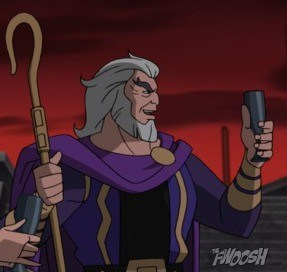
Batman / Kirk Langstrom


Created by Denny O'Neil and Neal Adams, Langstrom in the comic books turns himself by mistake into Man-Bat; as a classic mad scientist type, he's an INTP. Here he's an INTP also - only he turns himself into a vampire, not a bat.

We find, in Langstrom, an instance of an INTP subtype - here the Ne secondary function in the INTP makes itself just a little more than the dominant Ti function. This INTP subtype, being soft and dreamy, reminds us more of the Peter Parker INTP than the more hard-edged Reed Richards or Sherlock Holmes INTP (both of them Ti subtypes). But make no mistake, Lanstrom's scientific and analytical abilities, ineptitude and lack of social graces make him an INTP.

Vampirism, as a superpower, strikes me as being more an intuitive's power than a sensor's. Langstrom definitely seems to be an intuitive, not a sensor (Keirsey again).


Will Magnus


In the comic books, an INTP; here, an ENFJ. A crazy messianic type who wants to meld all of humanity into a uni-mind, he's definitely an ENFJ. Unlike the INFJ, who wants to redeem humanity through one-on-one counselling, the ENFJ wants to reach as wide an audience as possible and bring them together as one; Magnus' scheme - of showering billions of mind-controlling nanobots onto humanity dropped through boom tubes - serves to do just that. 

Tina 


The human Tina here gives a stock ESFJ who cares for just about everyone. She shows a lot of consideration for Magnus' friend Kirk Langstrom, which arouses Magnus' jealousy - even though it's a case of an ESFJ being an ESFJ. Whereas an ENFJ wants to convert and redeem as many people as possible, the ESFJ wants to take care of many as possible. 


Tin


The bumbling, self-effacing, adorable servant who performs useful tasks around the house - such as taking out the garbage - Tin is an ISFJ. He remains loyal to his master to the end, and loyalty defines an ISFJ.


Tina / Platinum


Deadly and efficient, smooth and graceful, doesn't talk a lot, good with weapons, tenacious and unyielding - how could robot Tina be anything other than an ISTP? Wheres the Platinum in the Metal Men comic books seems to be more of a zany, emotional, annoying type (ENFP?), Platinum here reminds us more of Elektra or Lashina in Jack Kirby's Fourth World (both ISTPs) - a slick and deadly female assassin.


That's the 13 characters - who did we leave out? The ESTPs, INFPs and ENFPs. Well, you can't fit all the types into one short movie... Gods- gives us thirteen, and what's more, we don't find any double-ups (more than one instance of a type).


Mark Hootsen signing off.