Showing posts with label Spiderman. Show all posts

Wednesday, 7 August 2019

MBTI: Why Bold and the Beautiful's worst ever storyline is like the Spiderman Clone Saga


 I. Bold and Spiderman


In past posts, I have compared the world's most popular soap Bold and the Beautiful (1987-) to a comic book, and recently, while watching an excellent video by Comic Tropes on Spiderman's famous Clone Saga story arc from the nineties, I was struck by the parallels between one of the sub-plots of the Spiderman story and the current main plot of Bold and the Beautiful.

In the Clone Saga, Peter Parker's wife Mary Jane Watson, carrying Peter's child, miscarries - or so she thinks. The truth is that, after blacking out in hospital, Mary Jane has given birth to a healthy child which is stolen from her by the supervillain Norman Osborne (the Green Goblin). On waking, she is told that she has miscarried. As to what happened to the child - after being abducted, it is placed in the care of an evil nanny, and is never heard from again; it disappeared from Spiderman continuity.

The writers and editors of Spiderman at the time may have decided to ditch the child abduction storyline because of an adverse fan reaction: the Clone Saga had proven to be highly unpopular with Spiderman readers, and so, in order to prevent any further alienation of the Spiderman fan base, Marvel opted for discarding the child abduction plot. Thereafter Marvel pretended that it had never happened.

Marvel probably made the right choice. But supposed it hadn't? Suppose it had persisted with it, and, to rub salt into the wound, focused on nothing else but Peter and Mary Jane's grief for an entire year? In this 'grimdark' iteration of Spiderman, the traditional Spiderman superhero fare - fighting Doctor Octopus, the Vulture, the Green Goblin - is neglected, and the readers are treated, over and over, to the sight of Peter and Mary Jane sobbing over their (presumed dead) baby's ultrasound photos. Because of the tragedy, Mary Jane and Peter divorce, and the baby winds up in the hands of one of Peter's ex-girlfriends (maybe Felicia Hardy or Liz Allen or Betty Brant or a reincarnated Gwen Stacy), who, having no idea that the baby belongs to Peter, adopts it (after paying a hefty fee) and raises it as her own. Not knowing that her baby survived, Mary Jane spirals into a depression and descends into madness - and becomes so crazy that, by the end of the arc, she becomes engaged to a supervillain. Meanwhile, Peter, in search of a family to belong to, ends up moving in with his ex-girlfriend and her adopted baby. Desperate to resume her relationship with Peter, his ex-girlfriend tells him that he should consider the baby to be 'his'. (Irony of ironies!)

As stated, the traditional Spiderman themes - superheroing and crimefighting - are to take a back seat in this storyline. To make matters worse (in the eyes of the fans), veteran characters such as Flash Thompson, J. Jonah Jameson, Robbie Robertson, Aunt May, Harry Osborn, are sidelined, and new, inconsequential supporting characters take their place. The new characters (interns at the Daily Bugle?) purport to be Peter and Mary Jane's friends, but one by one, discover the fate of the baby - and resolve to keep it a secret from the couple. Mary Jane and Peter mustn't know because, 'It is for the greater good', 'The baby went to a good home, after all', 'Peter and his ex are happy with their new family', 'If Mary Jane wants to break up with Peter and marry a monster, it's her own decision - she's an adult'. Later, the excuse becomes: 'We've kept the baby-napping secret for such a long time, we could all go to jail for not telling the police'. In effect, the new characters who are privy to 'the secret' blackmail each other into keeping quiet. In addition, as a quid pro quo, Norman Osborn bribes them with money.

The story concentrates on the minor characters to the exclusion of all others (except for Mary Jane and Peter), and the minors engage in endless debate as to whether or not to reveal 'the secret' and repeat, ad nauseam, the same arguments, the same catchphrases.

All of this would be met with hostility from readers, on the following grounds:


  • The usual fun and bright tone of the Spiderman series has been replaced with a dark and serious one. Most people don't enjoy reading stories about grim subjects - miscarriage and a woman's descent into post-partum depression. Spiderman readers buy the series because they want to see Spiderman do superheroics - e.g., battle Doc Ock, Electro and Mysterio, and thwart bank robberies.


  • The fact that the baby nappers (Norman Osborne and his gang) and their accessories after the fact (the minor characters) got away with their crimes offends the readers' natural sense of justice. The wrongdoers benefit from the crime while Peter and Mary Jane suffer: immorality is rewarded and goodness is punished.


This hypothetical Spiderman baby-snatch storyline follows the current Bold storyline to a tee. The story on Bold has gone on for eight long months - a record for Bold - to the exclusion of all others on what is usually a multi-storyline show. A grim tone now pervades what has always been a light, fluffy, camp and colourful TV series, and the central theme of Bold - the fashion industry - has been cast aside, as have veteran characters. The budget has been cut to the bone, and only a few sets - and a few actors - are used, over and over. Minor, new characters, have come to the fore. Longtime Bold watchers have been forced to endure them and their extraordinarily repetitious dialogue (which has been virtually the same day after day). Because of the change in tone, subject matter and characters (some of whom are acting out of character), Bold fans are leaving the series in droves, and while many fans may disagree as to which character is their favourite, all of them are united in hatred of the baby snatch storyline. And the makers of the show seemed to be oblivious to this. It is only recently that they show signs of waking up: they are bringing the baby snatch storyline to a juddering halt, and are wrapping it up prematurely, finishing it in August when they intended to string it out until November.


II.  Some background, some MBTI

Bold and the Beautiful revolves around two families: the Logans, a working-class family from the Midwest, who move to Los Angeles, and the Forresters, a wealthy Californian family (also originally from the Midwest) who run a fashion house called Forrester Creations. A third, smaller family, the Spencers - who run a publishing conglomerate, Spencer Publications - interweaves with the two main families.

This YouTube video gives a quick summary of the entire Bold saga, and the intermarrying and intercoupling of the three families, in six minutes. It covers the years from 1987 to 2008.

The above may make Bold seem complicated, but Bold really does make it easy for the viewer to understand what is going on. For one, Bold colour-codes the families for your convenience. You will notice that most of the Logans are blonde:


Ridge FORRESTER, the hero of the show, for most of the series is caught between two women - Brooke LOGAN, who is blonde, and Dr Taylor Hayes (née Hamilton), who is brunette. The family Ridge has with Taylor is brunette:


Hairstyle and accessories help differentiate a family as well. Bill Spencer II, the head of Spencer Publications, wears a goatee and so does his son, Liam. Two of his sons wear dagger medallions.


The Bold series shows a remarkable stability: four leading characters were played by the same actors for the first twenty-five years. During that time, two wilful and passionate women stood at the center of the Bold saga: Brooke LOGAN and Stephanie FORRESTER.


Brooke LOGAN leads the Logan family, which is from the beginning of the series female-dominated. In the first season, five of the family members are female and only one is male; the father - Stephen LOGAN - is absent, and has been absent for some time.

Brooke, an earthy, womanly and nurturing type, is portrayed as a slave to her passions - she has five children by four different daddies. I type her as an ESFJ.

Stephanie FORRESTER, mother of four children, leads the Forrester family. She is married to the gentle, dreamy and vacillating fashion designer Eric FORRESTER, who leaves her not once, but several times, for a woman who is much younger.  Each time Stephanie swears vengeance. Stephanie displays all the worst qualities of an ENFJ villain character: she is brooding, vindictive, controlling,  manipulative, bullying, temperamental, waspish and, in the words of Brooke, 'cruel'.

The rivalry - or enmity - between Brooke and Stephanie lasts for twenty-five years (Stephanie dies of cancer in 2012). Stephanie disdains Brooke, not only because Brooke marries Eric and bears him two children, but because Brooke marries Stephanie's two sons, Ridge and Thorne FORRESTER, as well. (In Bold, romantic partners are shared by father and son, brother and brother, sister and sister).

Brooke and Stephanie's personality types share the same leading function - Extraverted Feeling (Fe). Two types who share the same dominant function enjoy what Socionics calls a Kindred relationship.

The other long-standing rivalry, between Taylor Hayes and Brooke LOGAN, is called the 'Triangle of Doom' by Bold fans. Taylor, a psychiatrist, therapist and counselor, has for years competed with Brooke for the same man - Ridge. Taylor, who is somewhat unbalanced mentally and is forever catastrophising, sees herself as a downtrodden woman who is forever being taken advantage of. I type her as an ISFJ.


(Brooke, an ESFJ, and Taylor, an ISFJ, share the same personality functions but in a different order. The two types stand to one another in what Socionics calls a Mirror relation).

Since the 2000s, Taylor invented a narrative - which she repeats to all and sundry - that Brooke is a homewrecker who broke up Ridge and Taylor's marriage and stole Ridge. This reverses the truth: Taylor broke up Brooke's marriage, not the other way around. In 2002, Taylor dies (in what was the third of her three 'deaths' in the series - as in Marvel comics, death of a character is not forever) and Brooke is left to raise Taylor's three children by Ridge. After coming back to life in 2005, Taylor takes back Ridge (after thanking Brooke for helping raise the children), but soon cheats on him by kissing fireman Hector Ramirez. Because of this, and because Taylor confessed to a past infidelity with Dr James Warwick, Ridge leaves Taylor, who then plunges into an affair with Ridge's brother, the recently widowed Thorne FORRESTER. (Thorne's wife Darla died after being run over in a hit and run incident; the driver of the car was - Taylor).

Brooke's rivalry with Taylor, Taylor's narrative that 'Brooke wrecked my family with Ridge', Taylor and Stephanie's shared pathological hatred of 'The Logans', lit the fuse of the current baby-napping storyline - as we shall see.

III. Into the 2010s

In the next phase of Bold - after the 2000s - we meet the next generation of Logans, Forresters and Spencers. Brooke and Taylor's children from the 1990s, Hope LOGAN and Steffy and Thomas FORRESTER, reach adulthood, and Hope and Steffy go on to repeat their mothers' Triangle of Doom. You'll notice below that Hope (a Logan) is blonde, Steffy (a Forrester) is brunette:


What are the pair's personality types? Hope, a dreary, by the book martinet, turns her fashion line 'Hope for the Future' into a morality campaign, the objective of which is to persuade young women to save themselves for marriage. Because she practises what she preaches, her relationships with Oliver Jones and then Liam SPENCER suffer. Her sexually-frustrated fiancé Liam becomes an easy target for the predatory Steffy. I compare Hope to the Vulcans on Star Trek and type her as an ISTJ (like Spock).

Steffy, a vivacious, forceful, headstrong young woman, I type as an ESTP. (She reminds me of Lois Lane, another ESTP ). At the time that the adult Hope arrives on the scene, Steffy begins a relentless campaign to drive the Logans out of Forrester Creations. To that end, she lies, manipulates, bullies and seduces. She tries to steal Hope's boyfriend Oliver Jones and then Katie LOGAN's husband Bill SPENCER II (Katie is Hope's aunt). Failing both times, she succeeds with Hope's new fiancé Liam SPENCER (Liam is the son of Bill).

What are the relations between the ISTJ and ESTP types? Socionics calls them Contrary or Extinguishment relations. And on that note, there is another famous Contrary, ESTP-ISTJ pair: Captain Kirk and Mr Spock.

The overbearing and sanctimonious Hope and the dynamic and beautiful Steffy go to war over Liam, who, like Ridge before him, could be accused of vacillating - and playing the two women against one another (at least unconsciously). And so the second Triangle of Doom begins. Both women end up marrying Liam several times. Eventually, Hope, tired of Liam's lack of commitment (at some level, she senses that Liam isn't really into her), turns to Liam's half-brother Wyatt Fuller-SPENCER. She ends up marrying Wyatt in fit of pique with Liam (after Liam turns up ten minutes late for an appointment!) and becomes pregnant, but miscarries (in tried and true soap opera fashion - she falls down a flight of stairs). It is then the actress who plays Hope, Kim Matula, leaves the series.

IV.  A New Hope

Did that mean the end of the Hope Logan character? Not at all: after a few years, Hope was recast. And - as often happens when a character is recast - the personality type of the character changed.

In 2018, Liam had remarried Steffy just as his father, Bill Spencer II, was embarking on what is called in wrestling the 'Heel Turn': that is, Bill shifted from being a hero to a villain. After weeks of mutual flirting, Bill and Steffy enjoy a one-night stand. Remorseful, Steffy returns to Liam but keeps the encounter a secret, and the blissfully ignorant Liam renews his wedding vows with Steffy that same evening. Later, she takes a paternity test in secret (the child is proven to be Liam's) but Liam discovers the test after Steffy accidentally leaves the results hanging out of her purse. Shattered, Liam leaves Steffy and moves in to a roach motel. It is there that the new Hope, played by the lovely Annika Noelle, finds him - and nurses him through his trauma.

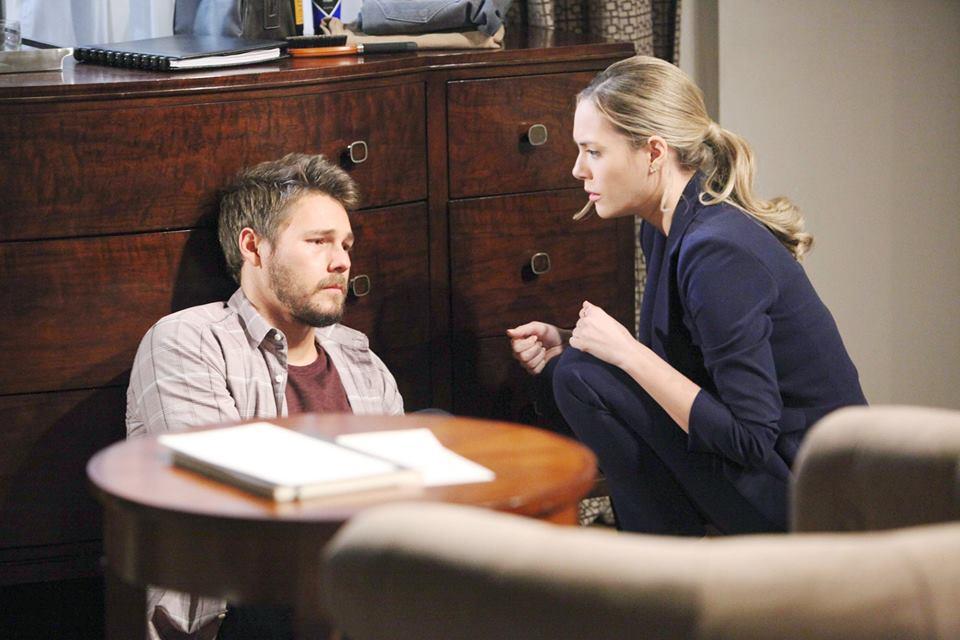


Hope's type has been change from a drab and humourless ISTJ to a warm and nurturing ESFJ, and we understand perfectly why Liam gravitates towards Hope and abandons Steffy. The 'Lope' relationship (the Liam and Hope relationship, as it is called by Bold fans) starts again but this time with a clean slate, as if Hope were a brand new character (which she is). 

Liam annuls his marriage to Steffy and becomes engaged to Hope - but, bizarrely enough, breaks off the engagement after he is persuaded to return to Steffy, who in the mean time has given birth to a girl, Kelly (named after Liam's deceased mother). Trouble comes in twos in soaps, and it turns out that Hope has become pregnant too. Hope and Liam marry, and at this point, tragedy strikes.

Taylor has returned to Los Angeles from one of her periodic absences, and is filled with fury that 'The Logans' have won again - that Hope LOGAN, daughter of Brooke LOGAN, has succeeded in winning Liam once again from Steffy. For whatever reason, Steffy has decided on having another child - a sibling for Kelly - and is expressing a desire to adopt. Taylor meets and has an affair with a gambling addict and crooked doctor, Reese Buckingham, who owes money to loan sharks who are threatening his and his daughter's lives. Taylor lets slip that she's prepared to pay big money for a baby for her daughter.

Liam and a heavily pregnant Hope prepare to travel to the resort island of Catalina. Liam misses the plane because - on Hope's insistence - he is to attend to his sick daughter, who is being looked after by Steffy. Storms and a blackout hit the island, and Hope goes into labour and gets taken to a deserted hospital where the only doctor on duty is - Reese Buckingham. In a grueling and nightmarish scene, Hope delivers a baby and passes out, and wakes up to find Liam (who has made his way to Catalina through the storm) by her bedside. The child was stillborn, Liam tells her, and Dr Buckingham hands them the baby's corpse. Liam and Hope hold it and collapse sobbing. The producers of Bold, for the show's 8000th episode, gave us one of its gloomiest ever.

V.  The Babynapping

In this episode and subsequent ones, the veteran Bold viewer will pick up on a few clues and begin to suspect that all is not as it seems; he may begin to wonder if Hope's baby may have somehow survived and the writers are steering Bold towards a classic baby-swap storyline. The changeling story - where one baby is stolen, or substituted for another - runs through the history of soaps like a motif.

Our suspicions are proven correct when it is revealed that Dr Buckingham switched Hope's baby Beth with the stillborn baby of another woman patient at the Catalina hospital that same night. Buckingham solicits the aid of an accomplice, Flo Fulton (a casino dealer from Las Vegas), to pose as a birth mother to the kidnapped child, who is sold to a gullible Taylor and Steffy for $250,000. ($50,000 goes to Flo as a payment for services rendered, the rest goes to the loan sharks).

The show takes a dark tone as Liam and Hope's marriage falls apart and Hope descends into an almost suicidal depression. She tells Liam to give up on her and go to Steffy, who is now the single mother of two baby girls and is dangling in front of Liam the prospect of a ready-made family. The subtext of Steffy's actions is, 'Why be with a woman who has suffered not one but two miscarriages when you can be with a woman who has two adorable little baby girls?'. Steffy keeps on telling Liam, over and over, that he is the 'father' of the little girl she has adopted (Steffy has named her Phoebe, after Steffy's deceased twin sister, Phoebe FORRESTER), that he should treat Phoebe as his own...

Steffy's brother Thomas FORRESTER returns to the series, and is recast. Just like Hope's, the character's personality type changes as a result. The new Thomas - the fourth adult version of the character - exhibits all the attributes of an INTJ bad guy: he is brooding, manipulative, dark, controlling - all in all, a stock villain type and a master planner, like Star Wars' Palpatine. This marks a dramatic change in Thomas. In his previous incarnations, Thomas showed moral lapses; in his latest, he becomes the soap's villain.


Thomas comes back to Los Angeles from New York after his partner, Caroline SPENCER (Liam's cousin), dies off-screen. Thomas has been left alone to raise their child, the five-year-old Douglas FORRESTER. Looking for a new wife, Thomas becomes obsessed with Hope, and putting on a mask of sorts to attract her, he plays the grieving widower part to the hilt. Hope, meanwhile, develops an attachment to the boy, and soon treats him as a substitute for the child she has recently lost. Hope - who is steadily becoming more and more crazy - becomes convinced that she must marry Thomas for the sake of 'that poor little boy' and that Liam must return to Steffy to be a 'father to the girls'. (This line of thinking is encouraged by Thomas, who pulls off plenty of tricks to gaslight Hope into marrying him).

Flo Fulton remains in Los Angeles after the baby has been adopted, and in quick succession, four (!) other new minor characters discover the truth about the baby swap. They engage in endless debate as to the rightness or wrongness of withholding the truth from Liam and Hope. Suffice to say, the truth is never told, as that would bring the story to a close.

The message of the storyline - and perhaps this is not one that the writers and producers intended - is that immoral behaviour is rewarded. The minor characters benefit by keeping quiet, Steffy gets her ex-husband back, Thomas gets a new wife. (Thomas becomes one of the people who discover 'the secret', and resolves, naturally, to keep that information to himself). Hope and Liam, meanwhile, are - like the Stark family in Game of Thrones - punished for their goodness.

VI. The end?

For eight long months, and a 150 episodes, the series has focused on the baby swap storyline. Normally, two or three storylines run in Bold simultaneously, and each of these is wrapped up fairly quickly. But this hasn't been the case here. All characters aside from Hope, Liam, Steffy, Thomas and the new, minor ones have been relegated to walk-on roles (if they are to appear at all), and the story has hardly moved on since the 8000th episode. We the viewers are subjected to the same conversations, day in, day out, regarding 'the secret', 'the girls Phoebe and Kelly', 'that poor little boy Douglas'. (The budget axe must have hit the show hard, as all these conversations take place at the same limited number of sets and actors). None of the characters appear to do any work, and the business side of Forrester Creations has been forgotten completely - in fact, it wouldn't surprise me if the company in this time has gone broke.

The two themes of the past eight months - miscarriage and post-partum depression - touch a sore spot for many of the show's viewers, particularly women, and it is here that the writers have displayed a remarkable insensitivity. The story could have been better handled if the phony miscarriage had been dropped down the memory hole as soon as it had happened, just as the writers of Spiderman did the same with Mary Jane Watson's. The characters could have then been moved on to something else.

The writers also missed an opportunity by not revealing the truth of baby Beth's abduction (and sale) until the last minute. Flo Fulton's character could have been taken at face value as the when she first appeared as the baby's birth mother; the audience did not need to be let in on the baby-swap scam straight away. But the writers instead took the same route as the old detective show Columbo, in which the identity of the murderer in every episode is known from the outset (see 'Inverted detective story').

But now, at last, the eight-month baby swap story has come to an end. The writers may have finished it sooner than they would have liked, but at some point, the makers of the show came to the conclusion that the series could not survive after alienating the loyal fanbase to such an extent. Were it that today's publishers of Marvel had such wisdom.

Mark Hootsen signing off.


Friday, 8 April 2016

MBTI: HOW TO TYPE SUPERHEROES


Comic books differ from other art forms - novels, plays, TV shows, movies - and we are faced with a different set of problems when typing a comic book character as opposed to one in a TV show.

When typing characters on a TV show such as Bold and the Beautiful, it's best to proceed as follows: get to know the 16 types and their little quirks and foibles really well and then attempt to recognise such-and-such a character as a typical instance of a certain type as seen in a TV show, comic book or movie.

On TV, character - and MBTI - is revealed to us in flashes: TV shows give us little pieces of a character at a time (from which we can divine a character's type). TV shows (and movies) can trace their forebear to the play, which is the oldest dramatic art form, and plays (according to Aristotle) only show slices of a character - not all of a character's life, only the most important moments of the character's life.

While comic books portray slices of life, comic book characters - especially superheroes and supervillains - reveal their type to us not only through their personality traits but their powers and abilities. As we shall see, some superpowers are more suited to an Intuitive type than a Sensor and vice versa.

If you cast your mind back to the superhero role-playing and card games of the 1980s and 1990s, you'll recall that usually each character's statistics reflect their strengths and weaknesses in certain areas. One of Superman's weaknesses lies in the field of the supernatural and magic, while Doctor Strange (as 'Earth's Sorcerer Supreme') exhibits mastery in that domain; the Silver Surfer possess the 'Power Cosmic', and is classified (along with Adam Warlock, Thanos, Galactus and Captain Marvel) in the Heroclix game series as a 'cosmic', while Spiderman doesn't show any propensity towards the 'cosmic' at all. One of my arguments here in this article is that these dichotomies - supernatural versus scientific, cosmic versus earthbound and others like them - bear upon MBTI and socionics.

I. Sensor or Intuitive?


We can define that dichotomy - Sensors versus Intuitives - in superhero land as being one of brains versus brawn. Characters whose powers and abilities tend to be mental (e.g., telepathic) or supernatural more often than not should be classified as Intuitives; so should characters whose ability (as opposed to superpower) could be said to be mental and intellectual (perhaps the character is a detective or a scientist) or consisting of some intangible quality such as 'charisma' or 'leadership'. On the other hand, Sensors will have, more often than not, a main power or ability based on strength, force and the use of weaponry; sometimes they will possess enhanced 'super-senses' (e.g., Wolverine, Daredevil). Intuitives tend to dwell in the mental or spiritual realm, Sensors in the material and sensory.

Take a look at some of the X-Men from the Chris Claremont years. Jean Grey, Professor X, Nightcrawler, Storm, Kitty Pryde, Longshot, Beast belong in the Intuitive category; Cyclops, Wolverine, Colossus, Rogue in the Sensor. Remember that Cyclops' main ability is to blast things with force beams from his eyes - force blasts, force bolts, the power to construct energy barriers and shields ('force manipulation') are a Sensor's power. Storm's power (weather control) and Nightcrawler's (teleportation) require a mental effort as opposed to the physical; or, to put it another way, an effort of thought as opposed to an effort of will. You could say that Nightcrawler must use intuition - extraverted intuition, Ne - to avoid teleporting ('bampfing' as he calls it) into the wrong place.


A character can start out as a Sensor and transform into an Intuitive, or vice versa. In her first appearance in an Avengers annual, Rogue plays the role of villain with the ability to siphon off or steal the super-powers and characteristics of superheroes - which, at first sight, makes her seem an Intuitive. But, after she steals Ms Marvel's powers and becomes an X-Men regular - and it's in that series that we get to know her - she becomes super-strong, super-fast, invulnerable; in short, she becomes a Sensor. Likewise, the Beast may seem to be a Sensor, but we mustn't forget that before he became a mutant he was Hank McCoy, a super-scientist, and, like Tony Stark / Iron Man, a rather extraverted and loquacious one at that. The fact that such an obvious Intuitive winds up as having the superpowers of a Sensor represents an intended irony; we find the same irony at work in Spiderman, a geeky and nerdy Intuitive who becomes super-strong.

In the Fantastic Four, we find two Sensors, two Intuitives. Mister Fantastic, as we know, can stretch, turn himself into rubber balls and all sorts of things, but let's remember the defining trait of the character (which made itself felt even before he gained superpowers): he's a brilliant inventor and scientist. That makes him an Intuitive... Like Green Lantern, Invisible Woman can construct invisible force-fields and objects which can be used as battering rams, etc., but these abilities were a later addition. Originally she was known for being able to turn herself (and objects and other people) invisible: more of a mental power than a physical. In contrast, the Thing owns a rocky and impervious body and can lift huge objects. This, to me, makes him a Sensor, and, what's more, can be related back to introverted sensing Si, which, as we know, involves physical strength, physical toughness and self-discipline. As for the Human Torch, his powers manifest themselves in the physical realm in a spectacular way. He blazes fire trails through the sky, makes and throws fireballs, overheats and blows up robots and machines, goes supernova... These demonstrate force, will, and force and will imposed on others - extraverted sensing Se.

In the case of the 'A-list' of DC characters, we find Sensor heroes Superman, Green Lantern, Green Arrow, the Flash and Intuitive heroes Batman, Robin and Wonder Woman. Green Lantern uses will power to make objects with his power ring, the Flash uses super speed to make his body a weapon (able to saw through objects or burn them up using friction, for example) - powers which are based on the sensory and the physical. Batman and Dick Grayson use their mental abilities to do detective work (as does Sherlock Holmes, another Intuitive) and are escape artists (like Mister Miracle, an Intuitive). Wonder Woman, as we know, can lift heavy objects, which should make her a Sensor, but I argue that an intangible quality - moral leadership or charisma - makes up her main ability, an ability she shares with Dick Grayson / Nightwing. Taylor types both Grayson and Wonder Woman as ENFJs, and ENFJ super-characters usually display an intangible, intuitive ability to lead and inspire (and manipulate).

We know that Magneto, Darkseid and Namor the Sub-Mariner possess all sorts of powers, but, if we're to trace back a main, or prime ability in these three, it's the ability to lead (or inspire fear in) men. The same goes for other Intuitive leader-types the Kingpin, the Red Skull and Loki.


The lesson is that we must always look at the fundamentals. In the case of the Spectre, we could be forgiven for thinking that he'd be an Intuitive like so many other Marvel and DC supernatural characters - e.g., the Phantom Stranger or Doctor Strange. But if you've read any of the Spectre comic books, it becomes clear early on that he's an ISTJ - a Sensor. That's because the character started out as an ISTJ: he's a police detective, Lieutenant Jim Corrigan, who comes back to life after being murdered by criminals as a vengeance-driven spook. That theme - the ISTJ as a vengeful supernatural entity - appears again and again in horror. Likewise, Boston Brand / Deadman, before being murdered, is a circus performer and a Sensor; ironically, he becomes transformed, after death, into a character with superpowers we normally associate with Intuitives - he turns into a ghost who can take over people's bodies.


I'll note here in passing that Sensors, particularly the extraverted-sensing ones, seem to be drawn to the use of weapons. Think of Daredevil (billy clubs), James Bond (handguns), Wolverine (claws), Elektra (sai daggers), Deathstroke the Terminator (swords and staves), Valkyrie from the Defenders (swords)... The archer characters spring to mind here also: both Oliver Queen / Green Arrow and Hawkeye are Sensors and both use bows and arrows. All these characters display an uncanny virtuosity when using their weapon of choice.


II. Thinker or Feeler?


Thinking and feeling make up, in socionics and MBTI, the two judging or 'Rational' functions. We make value judgements using either thinking or feeling, as do comic book characters. Dialogue and interplay gives us a fairly good idea of how a character will react to a certain situation and what value judgements they will make.

We see that in the famous Green Lantern and Green Arrow team-up stories by Neal Adams and Denny O'Neil . When confronted with an ethical dilemma, Green Lantern - as a Thinker - will consult the law: he asks himself, 'How does this look objectively and from the standpoint of accepted rules, morals, manners and customs?'. Green Arrow, on the other hand, will emote straight away. He reacts, instantly, and gives his interpretation - based on his own deeply-held moral convictions.

In the comic books, thinker characters tend to be  logical, detached, rational - but not always more intelligent - and calculating; if they don't possess much in the way of morals, they'll use deception if need be. Feelers, on the other hand, show an absence of guile and often find it difficult to detach themselves from their emotions and look at things objectively. Extraverted feeling revolves around what others feel and what their opinions, morals, habits are; introverted feeling, one's own moral evaluations and emotional reactions. A catchphrase of an extraverted Feeler superhero such as Superman is, 'Don't do that - it will hurt other people' ; for an introverted Feeler, 'Don't do that, because I don't like it'. Whereas, for extraverted thinkers such as the Punisher and Batman, things may be prohibited because they are unjust and go against The Law with a capital L -  a higher law than that of the America criminal justice system.

In the X-Men, Wolverine, Cyclops, Storm, Beast number among the rational and calculating types, whereas Professor X, Jean Grey, Nightcrawler, Colossus, Rogue, Kitty Pryde should be thought of as Feelers. The difference is illustrated by the contrast between Magneto and Professor X. Magneto, being a Thinker, looks at events from a calculating and technocratic perspective; Professor X's perspective, on the other hand, strikes us as empathic and moralistic, and always has a view to the common good. You see here the difference between extraverted thinking Te (Magneto) and extraverted feeling Fe (Professor X). Keirsey would classify Professor X, an NF (Intuitive Feeler) as an 'Idealist', Magneto, a NT (Intuitive Thinker) as a 'Rational'.


But wait, Thinking types - who have either Te or Ti as a judging function - get emotional, don't they? Obviously so: they can become just as emotional as Fe or Fi types. The difference lies in how they evaluate their experiences. The first question the Thinker type asks himself is, 'What are the rules on this? How does this thing work?'. Whereas the Feeler is more interested in the question of how such-and-such affects the group atmosphere or dynamic (Fe) or one's deeply personal and natural reactions (Fi), which can be ones of empathy or antipathy. It's how you sum up life - how you evaluate it - that counts.

This goes some way to explaining why some very intelligent characters such as Professor X - who invented the Danger Room and Cerebro, among other technological marvels - should be considered as Feelers, not Thinkers; and why some very ditzy characters such as Lois Lane or Janet Van Dyne are calculating Thinkers (after all, Lois Lane is (in the old comic books at least) always plotting how to get Superman to marry her; the Wasp does the same with Hank Pym).

III. Perceiver or Judger?


Taylor gives a good description of the differences between Perceiver and Judger below:

Judging or Perceiving (J/P)- Judging or Perceiving determines your lifestyle. While Judgers are more strict in their routines and prefer to have things finished, Perceivers are more likely to be okay with leaving things up in their air. Judgers go by a set of externalized rules that keep everything in place, while Perceivers live by internalized principles that guide them and only them. Like dogs and cats.

As Chad Crandall puts it, Judgers appear as 'mappers', Perceivers as 'explorers'.

Here's where it gets difficult. Spiderman, as an INTP, would, in socionics, be called an INTj - the small 'j' comes about because his dominant function (Ti) is a judging function. But, in MBTI, he's an INTP: the uppercase 'P' at the end signifies that his extraverted function is the perceiving one. And Spiderman (in comparison to the Punisher, for example, who is an ISTJ) seems more of a Perceiver than a Judger. So what gives?

I think that the point MBTI is trying to make is that the extraverted primary or secondary function determines how we appear to others: the extraverted function is the one the world sees, and the one that makes one (in the eyes of the world) a Judger or Perceiver. Barry Allen (the Flash in the old Silver Age DC comics) works as a police scientist and leads a structured and ordered life which we'd expect of a Judger. As an ISJF, his judging function - feeling - is extraverted and so it's the one that the rest of the world sees. And indeed, his rather snippy fiancé, Iris West, calls him a 'tortoise'.


It's not entirely true to say that Judgers (in MBTI) want to impose their values on the world while Perceivers don't - all the types, to a certain extent, seek to impose their values - but a great deal of truth exists in that assertion. Take the difference between Doctor Doom (a Judger) and Mr Fantastic (a Perceiver). Doom leads an orderly, structured life and works towards goals, and both activities involve other people: he wants to: conquer the world, rescue his mother from her imprisonment in Mephisto's hellish realm, destroy the Fantastic Four... This is what the world sees of Doom. Whereas, in the case of Reed Richards, we see a man who engages in scientific research for its own sake. He doesn't want to bring the world to heel. What's more, his extraverted function (the one the world sees), which is Ne, doesn't lend itself to world-conquering.

A Judger such as Doom wants the world to follow his rules (or at least expects, like Barry Allen, the world to follow a certain structure and is disappointed if it doesn't).

Judgers seem to be more rooted than perceivers. In the Fantastic Four, the two Judger characters in the foursome, the Thing and Invisible Woman serve to keep the team grounded - a necessity when the other half of the team (Human Torch and Richards) are Perceivers and somewhat flighty.

In the Claremont-era X-Men, we find plenty of Judgers - Professor X, Jean Grey, Storm, Rogue (surprisingly enough), Cyclops - who contrast against the 'wild card' Perceivers Wolverine, Kitty Pryde, Nightcrawler and the Beast. Likewise, in the seventies-era Defenders, the Judgers (Doctor Strange, Nighthawk) serve as a counterweight to the comparatively more erratic and unstable Valkyrie, Hellcat and the Hulk. In the eighties-era New Teen Titans, we find a lot of Judgers - Robin / Nightwing, Starfire, Wonder Girl / Troia, Raven, Cyborg, Kid Flash - and only two Perceivers (Jericho, Changeling). The last two were added so as to balance out the team. A good writer of superhero team comic books will deploy various MBTI types to give balance.


IV. Introvert or Extravert?


 Introversion or extraversion in a superhero can be measured by the extent to which he wants to be seen by other people and known by other people.

A superhero or supervillain base can give us a good idea of his extraversion or introversion. Introverted heroes or villains isolate themselves in their base or hideout from others. Doctor Doom (who lives in a remote castle), Batman (who lives in a cave), Doctor Strange (who lives in a spooky mansion in Greenwich Village), Mr Fantastic (who shuts himself away in a laboratory in the Baxter Building for days at a time), Wolverine (who takes off to the Canadian Rockies now and then to be by himself) give us examples of this. In contrast, Superman lives in a 'Fortress of Solitude', which sounds rather like an introvert's den, but a gigantic, highly visible metal door can be found at the entrance, and a few metres away we see a gigantic golden key pointing to that door. It's as though Superman wants to call attention to himself; the Fortress doesn't seem as concealed as Batman's Batcave. What's more, the interiors of the Fortress are brightly lit, and in a few rooms, we find prominent statues of Superman himself as well as his friends and family. Similarly, Darkseid's base - the planet Apokolips - is festooned with images and statues of its dread ruler. Let's not forget that Darkseid, in the Legion of Superheroes series, sculpted the planet Daxam to look like his head.

Extraverts such as Superman, Wonder Woman, Captain America, Robin, Luke Cage, Dazzler, Jack Kirby's Guardian, Green Arrow, Thor, Jean Grey / Phoenix wear brightly-coloured and eye-catching uniforms; introverts prefer to dark or muted outfits (think of Batman, the Punisher, Judge Dredd, Wolverine, Cyclops, Mr Fantastic, Doctor Strange, the Phantom Stranger, Raven, Professor X...). I'll note here that ISTJs such as Dredd, Punisher, Jack Kirby's Orion, Cyclops, the Spectre, Darth Vader like to conceal themselves behind helmets, hoods and visors.

One might point out that introverts such as Spiderman or Mister Miracle wear brightly-coloured, leery costumes: true enough. But what we find here is another instance of intended ironic contrast. The introverted and shy Peter Parker designed the gaudy Spiderman costume for the purpose of working in show business; likewise, the loner and introvert Scott Free inherited a uniform from his mentor Thaddeus Brown who was a professional theatrical performer.

Batgirl / Barbara Gordon and Nightwing / Dick Grayson patterned their uniforms after Batman's, whose colours certainly doesn't match Gordon or Grayson's extraverted personalities. But Gordon added some yellow to the design, and Grayson some yellow and years later, some red.

Generally, we can pick an introvert from an extravert by asking ourselves this question: does he want to be seen and acknowledged by others, or does he prefer to conceal himself and even live in darkness? Daredevil, in his civilian identity as Matt Murdock, wears shades, dark suits and attempts to make himself look as unobtrusive as possible. Much of his superheroing seems to be done in darkness, and on rooftops, and in that regard he resembles introvert heroes such as Batman and Spiderman. Nightcrawler has the power of becoming invisible in the dark. Cyborg of the New Teen Titans attempts to cover up his body by wearing caps and trench coats - he hates people staring at him. In contrast, his teammate Changeling / Beast Boy wants to be seen as much as possible; so does Superman, who patrols, in full view, in the skies above Metropolis. Iron Man / Tony Stark clearly likes being around other people, while the Silver Surfer, who floats above Earth on his surfboard, doesn't.

V. Putting it all together: the Scarecrow

It always helps, when typing a character, to read their first appearance and origin story. Below we find the a page of World's Finest Comics #3, which introduces the Batman villain Jonathan Crane, the Scarecrow. What can we learn from it?


Let's look at where Jonathan Crane fits in to the MBTI dichotomies:

THINKER OR FEELER?

It would seem obvious that the academic Crane, a teacher of psychology, would be a Thinker - but not so fast. Professor X is, after all, a professor, but I type him as a Feeler, not a Thinker. Crane is a Thinker, but this is revealed by his behaviour more than anything else, specifically by his calculating and reasoning. In the opening panels, he delivers a reasoned discourse - and a discourse on (not coincidentally) how to manipulate people. Thinker characters who are bad guys tend to be manipulative... Then, in the last panels of the page, we find him engaged in ratiocinations again: he's performing another set of calculations. Were he a Feeler, he'd be reacting in a different way to the scorn of his colleagues: 'Nobody likes me, my life is terrible! What shall I do...'. His colleagues - and the world at large - doesn't respect him, but instead of reacting, he acts; he becomes determined to get even. He thinks in terms of problems and solutions.

INTROVERT OR EXTRAVERT?

The question answers itself. Crane resembles other brooding, isolated loner characters the Punisher, Wolverine, Peter Parker, and Bruce Wayne himself. He lives in a gloomy pad. A mousey-looking man, he doesn't want to draw attention to himself, neglects his appearance and wears shabby clothes (later on we'll see that the colours of his costume are dark and muted).

Let's go on to the next page...


JUDGER OR PERCEIVER?

Does Crane lead an orderly, structured life? Or does he take life as it comes? We see that Crane - like the other Judger characters who appear in that issue (Bruce Wayne, Clark Kent and Dick Grayson) - leads the same life, day in, day out; he isn't as erratic as Peter Parker, who aspired to work in academia for a while and made a poor teacher and student. Crane begins the story in the classroom, goes back to his pad, broods, comes back to class the next day, returns home and broods some more ('In his home, Crane's distorted brain begins thinking along fantastic lines - criminal lines'). This is a man who is accustomed to regularity and an even rhythm in his life.

Does he seek to impose his values on others? Yes indeed. Perceivers such as Reed Richards, Peter Parker, Wolverine, Oliver Queen (the bearded one in the comics, not the TV one) hold strongly-felt values but really don't care if the world is congruent with those values or not; they won't strive particularly hard to change anything. Scarecrow, on the other hand, does want to bring the world in line with his values: specifically, he wants to induce fear in others - and, at the same time, make money and gain prestige from doing so.

INTUITIVE OR SENSOR?

Do Crane's abilities and / or powers use brains or brawn? Obviously, the Scarecrow relies on his brains, and his power - altering the emotions of others (using special chemicals) - makes him an Intuitive character, not a Sensor.

In Socionics, intuitive intuition Ni is understood to be the perception of time and also cause and effect. Crane's broodings and ratiocinations are all about discovering the principles behind human psychology and how a certain cause (making people afraid) brings about a certain effect (making him wealthy and powerful).

SUMMING SCARECROW UP: INTJ

Crane is an Introvert, an Intuitive, a Thinker and a Judger. Taking into account Crane's displays of introverted intuition (planning, study of cause and effect) and his extraverted thinking (organisation of data), we can conclude he's an INTJ (INTp in Socionics). And that's how Taylor types him. It's no accident that his origin story and his character resembles other INTJ characters Doctor Doom and Batman himself - doesn't Crane's Eureka moment ('So I look like a scarecrow - that will be my symbol - a symbol of poverty and fear combined! The perfect symbol - the Scarecrow!') remind you of Bruce Wayne's?


Mark Hootsen signing off.